
How to Make Cold Brew Coffee at Home
A smooth, low fuss walkthrough from the first scoop to the last sip.
If you have ever paid a few dollars for a cup of cold brew and wondered how a coffee shop gets it so mellow, here is the secret: there is no secret. Cold brew is just coffee grounds, cold water, and time. No special machine, no barista training, and almost no effort on your part.
So, how do you make cold brew coffee that actually tastes good? This guide covers the whole process. You will learn the right grind, the ratios that work, how long to steep, three easy ways to brew, and how to fix a batch that comes out weak or bitter. By the end, you will know how to make great cold brew coffee at home for a fraction of the café price.
The short version
- Grind your beans rough and chunky, noticeably coarser than you would for drip.
- Pour 4 cups of cold water over 1 cup of grounds in a roomy container.
- Stir until all the coffee is soaked, then put a lid on it.
- Leave it to soak for 12 to 18 hours, at room temperature or in the refrigerator.
- Remove the grounds in two passes: a sieve first, then a paper filter.
- Thin it with water or milk, pour it over ice, and refrigerate whatever is left.
🧊 What Is Cold Brew Coffee?
Cold brew gets its name from how it is made: ground coffee sits in unheated water for most of a day, rather than meeting near boiling water for a few minutes. With no heat driving things along, flavor comes out gradually. Plenty of drinkers describe the result as mellower and easier on the palate than hot coffee, with a sweet, cocoa like finish.
That is also what separates cold brew from iced coffee. Iced coffee is regular hot coffee that has been chilled, usually poured over ice. Cold brew never sees a hot kettle at all. The difference shows up in the cup, and it is the reason cold brew has become a favorite for warm days and slow mornings.
| Feature | Cold brew | Iced coffee |
|---|---|---|
| How it is made | Grounds steep in cold water for 12 or more hours | Brewed hot, then cooled |
| Time needed | Overnight, mostly hands off | A few minutes, plus cooling |
| Flavor | Smooth, mellow, often sweeter | Brighter, sharper, more acidic |
| Strength | Usually made as a concentrate, then diluted | Brewed at normal strength |
| Keeps in the fridge | Around a week or more | A day or two before it tastes stale |
🛒 What You Need
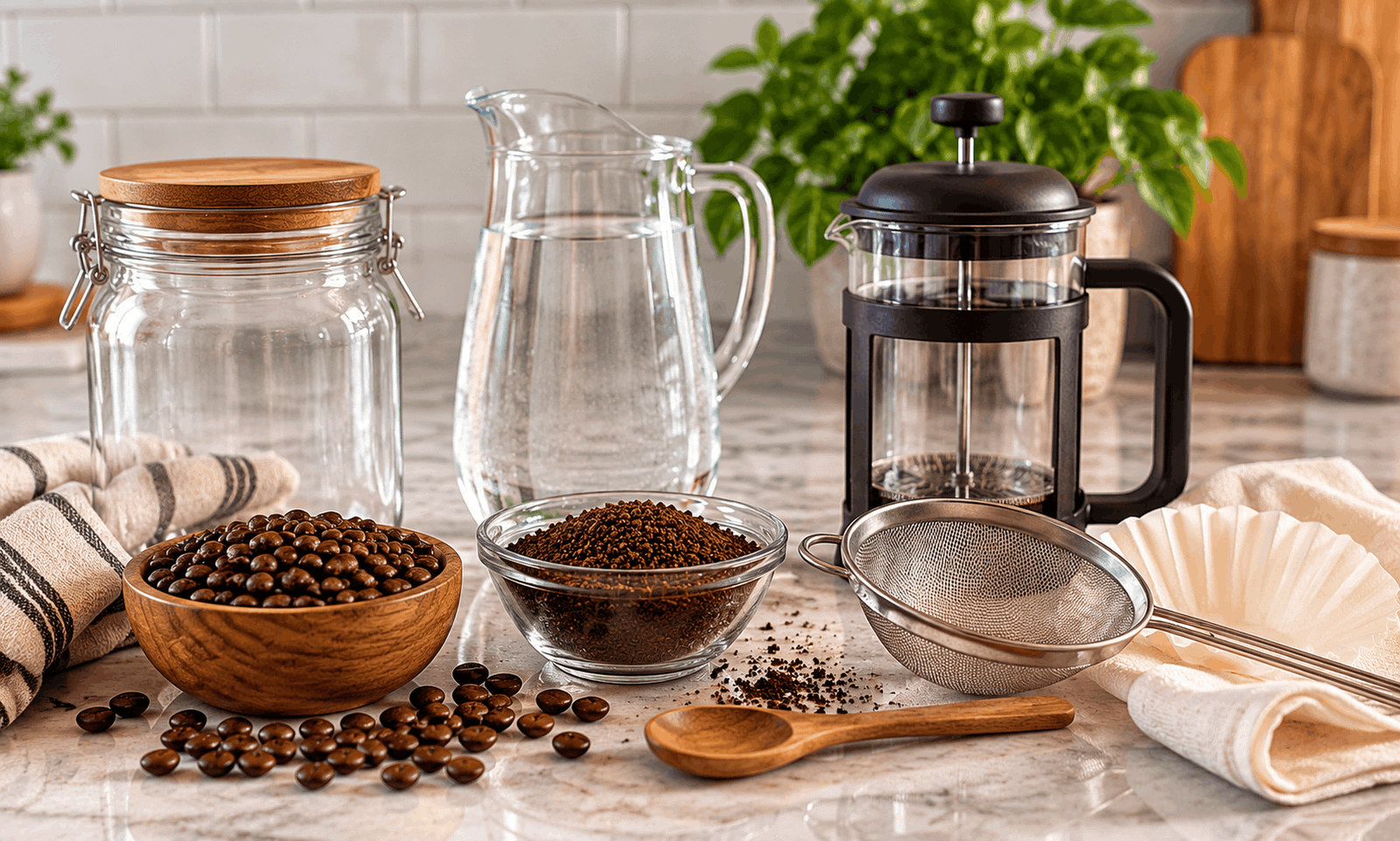
The equipment list is short, and you probably own most of it already.
- Coffee beans, or pre ground coffee labeled coarse
- Cold, filtered water
- A roomy container, such as a jar, pitcher, or French press
- A scale or measuring cups
- A spoon for stirring
- Something to strain with: a sieve, plus paper filters or a clean cotton cloth
- A lidded bottle for storing the finished coffee
🫘 Picking the Right Beans and Grind
This is the step that decides whether your batch tastes great or just okay, so it is worth a minute of attention.
The beans
Almost any coffee works, but medium and dark roasts are the classic choice because their chocolate, nut, and caramel notes come through beautifully in a slow, cold soak. Lighter roasts can taste fruity and bright, though they sometimes come out a bit thin, so you may want to steep them a little longer. Fresher beans taste better, so buy whole beans when you can and grind them just before brewing.
The grind
Aim for a rough, chunky grind where you can still pick out individual pieces, rather than anything powdery. Because cold water extracts so slowly, bigger particles keep the soak from going overboard. Powdery grounds hand over too much too quickly, which tastes harsh and leaves silt behind that gums up your filter.
Shopping for coffee that is already ground? Check the label for words like French press or cold brew. Regular drip grounds are far finer than you want here and tend to give a gritty, sharp tasting result.
⚖️ The Right Coffee to Water Ratio
Ratio is where most home batches go wrong. Cold brew is usually made as a concentrate, which means a lot of coffee in a little water. You then dilute it to taste when you pour a glass. Making it this way saves fridge space and gives you control over strength.
| Style | Ratio (coffee to water) | Example | How to serve |
|---|---|---|---|
| Concentrate | 1 to 4 or 1 to 5 by weight | 1 cup coarse grounds to 4 cups water | Mix with equal parts water or milk |
| Ready to drink | 1 to 8 by weight | 1 cup coarse grounds to 8 cups water | Pour straight over ice |
If you are new to this, start with the concentrate. It is more forgiving, because you can always add water to a batch that is too strong, but you cannot fix one that is too weak.
👩🍳 Step by Step: How to Make Cold Brew Coffee
Measure your coffee
For a first batch, use 1 cup of coarse ground coffee. If you have a scale, weigh it for repeatable results. Write down what you used so you can adjust next time.
Grind it coarse
If you are working with whole beans, turn your grinder to one of its roughest settings. Grinders with burrs produce the most uniform pieces. If all you own is a blade grinder, run it in brief pulses and give it a shake in between so nothing gets pulverized.
Combine with cold water
Tip the grounds into your container, then add 4 cups of chilled water in a slow stream so the coffee saturates evenly instead of balling up.
Stir until everything is wet
Give the mixture a gentle stir, making sure no dry pockets are hiding at the bottom or floating on top. After a few minutes, stir once more to push down any grounds that rose to the surface.
Cover and steep for 12 to 18 hours
Put a lid on the container and walk away. Out on the counter, extraction moves along faster, and 12 to 16 hours usually does the job. Inside the refrigerator things move more slowly, so figure on 16 to 20 hours.
Strain it twice
Start by pouring everything through a sieve to remove the bulk of the grounds. Then run the liquid through a second, finer barrier, such as a paper filter or a piece of clean cotton cloth, to trap the leftover silt. Resist pressing on the grounds. Squeezing forces bitter, cloudy particles into your coffee, while patience and gravity give a cleaner result.
Dilute, serve, and store
Taste the concentrate on its own, then mix it with equal parts cold water or milk and pour it over ice. Move the rest to a sealed bottle and keep it in the fridge.
🫙 Three Easy Ways to Brew It
The method is always the same: soak, wait, strain. What changes is the container, and the one that works best is mostly about what you already have.
Mason jar
The simplest setup. Great for small batches, cheap, and easy to fit on a fridge shelf. Straining takes a bit more patience, since you will need a sieve and a filter.
French press
Add the grounds and water, steep, then press the plunger down slowly to separate them. It strains most of the grounds for you, though a second pass through a paper filter gives a cleaner cup.
Cold brew pitcher
A pitcher with a built in mesh filter makes the whole process nearly effortless. Lift the filter out when the time is up and your coffee is ready to pour.
⏱️ How Long Should You Steep?
Steep time changes strength and flavor more than almost anything else. These are starting points, so use them to find your own sweet spot.
| Steep time | What to expect |
|---|---|
| 8 to 12 hours | Lighter and milder. Good if you like a gentle cup, but it can taste weak. |
| 12 to 18 hours | The sweet spot for most people. Balanced, smooth, and full of flavor. |
| 18 to 24 hours | Bolder and heavier. Past this point, bitterness can creep in. |
🏆 Tips for Making the Best Cold Brew Coffee
Want to know how to make the best cold brew coffee you have ever had? A few small habits separate a good batch from a great one.
- Use filtered water. Coffee is mostly water, so any off flavors in your tap will show up in the cup.
- Buy fresh beans. Stale coffee makes flat cold brew, no matter how carefully you steep it.
- Weigh your coffee. A scale takes the guesswork out and makes every batch match the last one.
- Keep the grind consistent. Uneven pieces extract unevenly, which is a common cause of bitterness.
- Strain twice. A paper filter pass is what turns a cloudy batch into a clean, silky one.
- Start with a clean jar. Old coffee oils from a previous batch can make a new one taste off.
- Keep a quick log of your grind, ratio, and hours. Changing several variables at once makes it impossible to tell what actually helped.
🔧 Troubleshooting Your Batch
| The problem | The likely cause | The fix |
|---|---|---|
| Tastes weak or watery | Too little coffee, too short a steep, or too fine a dilution | Use more grounds, steep longer, or add less water when serving |
| Harsh or bitter taste | Powdery grounds, or a soak that ran too long | Coarsen the grind and pull the jar a few hours earlier |
| Tastes sour or flat | Under extracted, often from a short steep or a light roast | Steep longer, or move it from the fridge to the counter |
| Cloudy or gritty | Fine particles passed through the filter | Strain a second time through paper and do not squeeze the grounds |
| Flat, lifeless flavor | Beans past their prime, or a jar with leftover residue | Buy a fresher bag and rinse the container thoroughly |
🥤 Ways to Serve Your Cold Brew
Once you have a jar of concentrate waiting in the fridge, the options open up.
- Classic over ice. Equal parts concentrate and cold water, poured over ice.
- With milk. Swap the water for dairy or a plant milk for a creamy, café style drink.
- Lightly sweetened. Stir in a little simple syrup, honey, or maple syrup. Sweeteners dissolve much better in cold brew than they do straight into ice.
- Flavored. Try a splash of vanilla, a pinch of cinnamon, or a spoonful of cocoa.
- Coffee ice cubes. Freeze some cold brew in a tray so your drink never gets watered down as it melts.
📦 How to Store Cold Brew
Pour the finished coffee into a bottle with a tight lid and refrigerate it. Undiluted concentrate tastes its best for roughly a week to ten days. Once it has been mixed with water or milk, plan to drink it within a day or two. If it ever smells sour, toss it and brew a new batch.
❓ Frequently Asked Questions
How do you make cold brew coffee without special equipment?
A jar, a spoon, and a sieve cover it. Stir rough ground coffee into cold water, leave it overnight, then pour it through a sieve lined with a paper filter or a clean cloth.
Should I steep on the counter or in the fridge?
Both give good results, so it comes down to timing. A counter soak finishes sooner, at around 12 to 16 hours. A refrigerator soak takes about 16 to 20 hours and tends to taste a touch softer.
Can I use pre ground coffee?
You can, as long as the grind is rough enough. Bags made for French press are a safe bet. Standard drip grounds give up their flavor too quickly and slip through filters, so the coffee ends up harsh and silty.
Can I make cold brew with hot water to speed it up?
Hot water gives you a different drink. It extracts faster, but you lose much of the smooth, mellow character that cold brew is known for. If you are short on time, a longer room temperature steep is the better route.
Does cold brew have more caffeine?
It depends. Concentrate can be quite strong per ounce, but once you dilute it, a typical glass lands in the same general range as a regular cup of coffee. The exact amount changes with the beans, the ratio, and the steep time.
What makes homemade cold brew bitter?
Two things cause it most often: powdery grounds, or a soak that lasts too long. On your next batch, coarsen the grind or pull the jar out a few hours sooner.
Do I need to use expensive beans?
No. Fresh, decent quality beans matter more than a fancy label. Pick a roast you already enjoy and build from there.
🏁 Final Thoughts
Learning how to make my own cold brew felt like a small revelation for a lot of coffee lovers: it takes ten minutes of work, one night of waiting, and the payoff lasts all week. Begin with the simple ratio above, change a single variable per batch, and before long you will have a recipe tuned exactly to your taste.
Ready to put it all into practice? Our simple cold brew coffee recipe gives you exact measurements and a printable style recipe card, so you can mix your first batch tonight.
Ready to mix your first batch?
Get Our Simple Cold Brew Coffee Recipe