

The one number that decides whether your coffee tastes weak, bitter, or just right.
Ask ten coffee people how to fix a disappointing cup and nine of them will say the same thing: check your ratio. Before you spend money on fancier beans or a new machine, it pays to look at how much coffee you are putting into how much water. Get that right, and even ordinary beans taste noticeably better.
The good news is that the math is simple. Below you will find the recommended coffee to water ratio for most people, a handy calculator, a chart that shows the coffee to water ratio in tablespoons and grams, the best ratio for each brewing method, and a plain explanation of how to adjust when a cup is not quite right.
This post contains affiliate links. If you buy through them, we may earn a small commission at no extra cost to you. As an Amazon Associate, we earn from qualifying purchases.
The short version
- Begin at 1:16, which is roughly 62 grams of coffee (about 12 tablespoons) for a liter of water (about 4 cups).
- No scale? Count out level tablespoons, about two for each 6 ounce serving.
- If it tastes thin, add coffee.
- If it tastes heavy, add water.
- Adjust a single variable per batch and keep notes on the result.
What Is a Coffee to Water Ratio?
A coffee to water ratio, which some people call the water to coffee grounds ratio, describes how much ground coffee goes into a pot compared with the water that runs through it. Numbers like 1:16 are shorthand. For every single unit of coffee, you add sixteen units of water.
Since a milliliter of water weighs about a gram, grams and milliliters can be swapped freely. Brew 30 grams of coffee (6 tablespoons) with 480 ml of water (2 cups) and you have made a 1:16 pot. A smaller second number means a more concentrated drink, so a 1:12 brew will taste noticeably punchier than a 1:18 one.
Think of ratio as a volume knob. It sets how loud the coffee flavor is, but it cannot tell you whether the cup is balanced. Sourness and bitterness come from extraction, which depends on how fine you grind, how long the water touches the grounds, and how hot that water is. Keep that distinction in mind, because blurring the two is why so many people keep tweaking without improving anything.
The Recommended Coffee to Water Ratio (the Golden Ratio)
You will often see the recommended coffee to water ratio called the golden ratio. The Specialty Coffee Association’s long standing guideline recommends around 55 grams of coffee (11 tablespoons) for each liter of water (about 4 cups). Converted, that lands near 1:18. In home kitchens, brewers often go a bit bolder, anywhere from 1:15 to 1:17.
Treat that as a range, not a law. A ratio of 1:16 sits comfortably in the middle and makes a friendly starting line. Move away from it in small steps until the cup suits you.
| Ratio | Strength | What it tastes like |
|---|---|---|
| 1:15 | Strong | Bold and full, the kind of cup that holds up to milk |
| 1:16 | Balanced | A dependable middle ground that suits most beans |
| 1:17 | Mild | Softer and easier to sip, with flavors that come through clearly |
| 1:18 | Light | Light and delicate, a good match for bright, fruity roasts |
Quick Ratio Calculator
Skip the mental math. Enter how much water you plan to brew and pick a ratio, and the calculator will tell you how much coffee to measure out.
Coffee to Water Ratio Chart: Tablespoons and Grams
Prefer a chart you can screenshot? This coffee to water ratio tablespoons chart uses a balanced 1:16 ratio. Tablespoons are rounded, since the weight of a tablespoon changes with the grind and the roast. A scale is always more accurate.
| Water | Coffee (grams) | Coffee (tablespoons, approx.) |
|---|---|---|
| 4 oz (1/2 cup, 120 ml) | 7 g | 1 1/2 tbsp |
| 8 oz (1 cup, 240 ml) | 15 g | 3 tbsp |
| 12 oz (1 1/2 cups, 355 ml) | 22 g | 4 1/2 tbsp |
| 16 oz (2 cups, 475 ml) | 30 g | 6 tbsp |
| 24 oz (3 cups, 710 ml) | 44 g | 9 tbsp |
| 32 oz (4 cups, 945 ml) | 59 g | 12 tbsp |
| 48 oz (6 cups, 1.4 L) | 89 g | 18 tbsp |
| 64 oz (8 cups, 1.9 L) | 118 g | 24 tbsp |
Best Ratio for Each Brewing Method
Different brewing methods pull flavor out of the grounds in different ways, so each one has a sweet spot. Treat these as starting points and adjust to taste.
| Method | Typical ratio | Example |
|---|---|---|
| Automatic drip | 1:15 to 1:17 | 60 g of coffee (12 tbsp) for 1 liter of water (about 4 cups) |
| Pour over | 1:15 to 1:17 | 20 g of coffee (4 tbsp) for 320 ml of water (about 1 1/3 cups) |
| French press | 1:12 to 1:15 | 30 g of coffee (6 tbsp) for 400 ml of water (about 1 2/3 cups) |
| AeroPress | 1:12 to 1:15 | 15 g of coffee (3 tbsp) for 200 ml of water (just under 1 cup) |
| Espresso | 1:2 (by liquid weight in the cup) | 18 g of coffee (about 3 1/2 tbsp) for about 36 g of espresso (about 1 1/4 oz) |
| Cold brew concentrate | 1:4 to 1:5 | 100 g of coffee (20 tbsp) for 450 ml of water (just under 2 cups) |
| Cold brew, ready to drink | 1:8 | 100 g of coffee (20 tbsp) for 800 ml of water (about 3 1/3 cups) |
Notice that immersion methods like the French press run a little stronger than drip. Cold brew is richer still, because it is usually made as a concentrate. If you make it at home, our cold brew guide walks through the full process.
Handy Tools for Measuring Your Coffee
A few inexpensive tools make it much easier to hit your ratio every time. Here are some options to consider.
These are affiliate links. We may earn a commission if you buy through them, at no extra cost to you. The images shown are for illustration only and are not photos of the actual products, so what you receive may look different. Please check the Amazon listing for the real product images, details, sizes, features, and pricing before you buy.
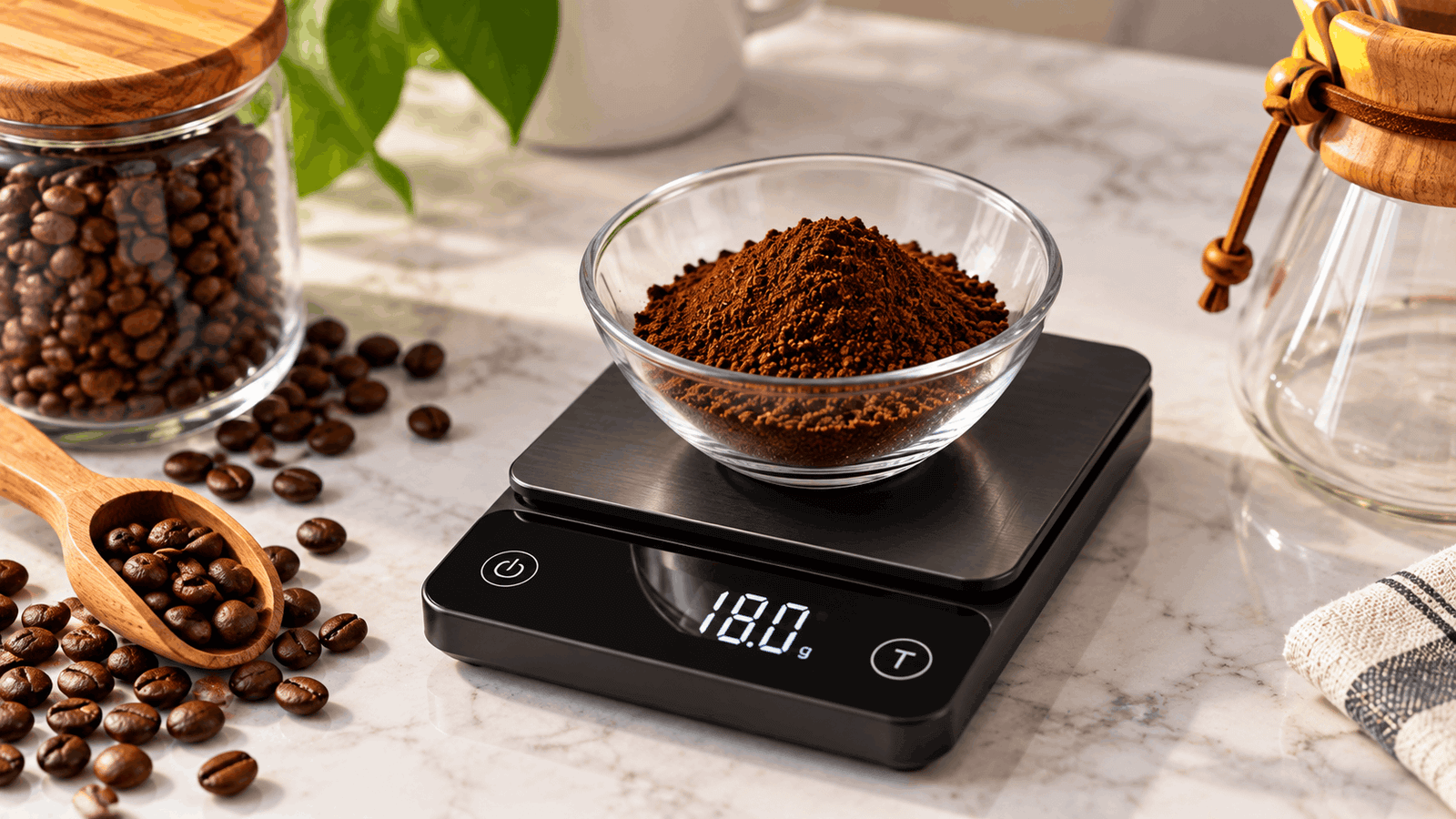
RENPHO Espresso Scale with Timer
A digital coffee scale with a built in timer. It makes weighing your grounds easy, and the timer helps with pour over and espresso.
View on Amazon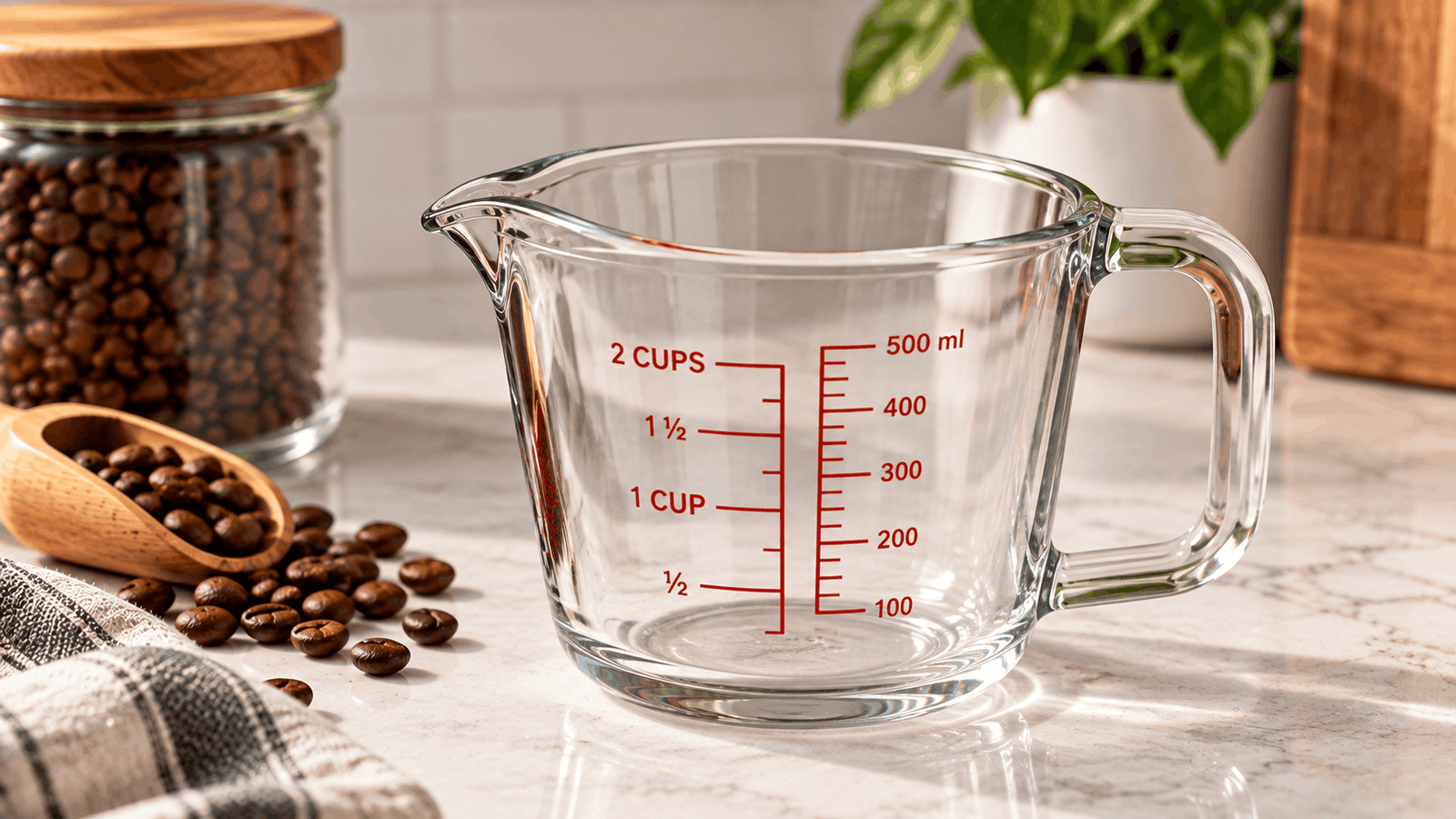
Pyrex Essentials (2-Pack) Glass Measuring Cups Set
Glass measuring cups for portioning your water. A handy way to get the right amount in without a scale.
View on Amazon
4 PCS 6.7 Inches Coffee Spoons
A set of four long handled coffee spoons, a good size for stirring your brew or measuring out grounds.
View on Amazon
Amrules Milk Frothing Pitcher 12oz
A 12 ounce pitcher for steaming and pouring milk. Useful once your ratio is dialed in and you want to make lattes and cappuccinos.
View on AmazonWeigh It or Scoop It?
Scoops are quick, but they measure volume, and coffee does not take up the same room every time. Dark roasts swell in the roaster, so they fill a scoop with fewer grams than a denser light roast does. Grind size changes the packing too. That means one bag can deliver a different dose than the next, even with an identical scoop.
A basic kitchen scale costs very little and solves the problem. Weighing takes a few seconds and means tomorrow’s pot can match today’s. If you would rather stick with scoops, these numbers help:
- A level tablespoon of ground coffee comes in around 5 grams.
- A standard coffee scoop is about two tablespoons, close to 10 grams.
- The classic rule of thumb pairs one scoop with each 6 ounces of water.
- The cup lines on a carafe are built around a small serving, often 5 to 6 ounces, which is well under what a mug or measuring cup holds.
How to Adjust Your Coffee Strength
Once you have a baseline, tweak it with small moves. Changing by a single step, such as going from 1:16 to 1:15, is plenty.
Want it stronger?
Raise the coffee while keeping the water the same. Going from 1:16 to 1:15 on a 500 ml pot (a little over 2 cups) adds roughly 2 grams, which is less than half a tablespoon.
Want it milder?
Cut the coffee slightly, or simply stir a splash of hot water into your mug after brewing.
Not sure?
Brew at 1:16 first and taste it black. Deciding after a sip beats guessing.
Weak, Sour, or Bitter? Ratio vs. Extraction
This is the part that trips up most people. Ratio sets strength. Extraction sets how balanced the flavor is. A cup can be strong and bitter, weak and sour, or any other combination, so it helps to know which lever to pull.
| What you taste | The likely cause | What to try |
|---|---|---|
| Thin, watery, little flavor | Not enough coffee for the water | Use more coffee, or a tighter ratio like 1:15 |
| Heavy, overwhelming, too intense | Too much coffee for the water | Use less coffee, or a looser ratio like 1:17 |
| Sour, sharp, or salty | Under extracted | Grind finer, brew a little longer, or use hotter water |
| Bitter, harsh, or dry | Over extracted | Grind coarser, shorten the brew, or lower the water temperature |
Common Ratio Mistakes
- Measuring by eye. Eyeballing leads to a different cup every morning. Measure, even roughly.
- Mixing up cups. A “cup” on a coffee maker is not the same size as a cup in your kitchen, so check your machine’s markings.
- Changing everything at once. If you alter the ratio, grind, and time together, you will never know what helped.
- Blaming the ratio for a bitter cup. Bitterness is usually a grind or brew time issue, as the table above shows.
- Using stale coffee. A perfect ratio cannot rescue beans that are long past their best.
Tips for Getting It Right
- Buy a scale. It is the single biggest upgrade for consistent coffee.
- Write down your recipe. Note the ratio, grind setting, and brew time for the cup you love.
- Start balanced. Brew your first cup at 1:16, then adjust one step at a time.
- Use fresh, filtered water. Water makes up almost all of your cup, so it matters.
- Grind just before brewing. Whole beans stay fresh longer than pre ground coffee.
Frequently Asked Questions
What is the recommended coffee to water ratio?
The recommended coffee to water ratio for most brewers is 1:16. Tighten it toward 1:15 for a bolder pour, or loosen it toward 1:17 for a gentler one. There is no single winner, so treat 1:16 as your starting point.
What is the coffee to water ratio in tablespoons?
A dependable rule is 2 level tablespoons of ground coffee for every 6 ounces of water. For an 8 ounce (1 cup) mug, that works out to about 3 tablespoons. Use the chart above to scale it up for a bigger pot.
How much coffee per cup should I use?
For a standard 8 ounce (1 cup) mug at 1:16, aim for around 15 grams of grounds (about 3 level tablespoons). If your machine measures cups at 5 or 6 ounces, use proportionally less.
How many scoops of coffee for a 12 cup coffee maker?
Many 12 cup machines count a cup as about 5 ounces, which makes the full pot about 60 ounces (7 1/2 cups). At the standard guideline of one scoop (2 tablespoons) per 6 ounces, that comes to roughly 10 scoops, or about 105 grams (roughly 21 tablespoons). Check your machine’s manual, since sizes vary.
Does the ratio change for dark roast or light roast?
The ratio can stay put. What shifts is how a scoop behaves, since puffier dark roasts hold fewer grams per scoop. Weigh your coffee and you can use the same ratio for both, then taste and adjust.
What ratio should I use for iced coffee?
Because ice will dilute the drink, brew it a little stronger than usual, such as 1:14 or 1:15, and pour it over a full glass of ice. You can also chill a regular batch and drink it over fewer cubes.
Is a stronger ratio the same as more caffeine?
Generally, yes. More coffee per cup means more caffeine in that cup, though the exact amount also depends on the beans and how you brew.
Do I need a scale to get the ratio right?
Not strictly. Spoons and scoops land you in the right neighborhood, while a scale makes the result repeatable from one morning to the next.
Final Thoughts
A coffee to water ratio is the simplest tool you have for better coffee at home. Start at 1:16, taste what you brew, and move one small step at a time until the cup is exactly how you like it. Once you find your number, write it down and keep it.
Want to keep improving your coffee at home? Our guides cover everything from brewing methods to keeping your coffee maker clean.
Ready to level up your coffee?
Browse All of Our Coffee Guides